Sunday, September 8, 2013

Little Chapel on the River

Bibliography
Bounds, Gwendolyn. Little Chapel on the River. New York: Harper Collins, 2005. Print.
image from: http://www.gwendolynbounds.com/images/Littlechapel_hc-330-exp.jpg


My Thoughts
I believe that I read books when I am supposed to read them. I just finished this book, and it occurred to me today that this week is 9/11. The event is a catalyst that made this story even happen....strange how I read it and finished the book so close to the anniversary of the devastation. When I started this book, I had no idea. This was another ARC that I decided this was the summer to read it!

This turned out to be non-fiction, but it reads like a novel. The author Gwendolyn (Wendy) lived in NYC just blocks away from the World Trade Center. When the terrorists attacked, she was forced to leave her apartment. She ended up renting a house in Garrison, New York--a commuter train ride away from the city. Bounds worked at The Wall Street Journal. This training helps her capture the essence of Garrison, and more specifically the Irish pub, Guinan's, in this sleepy book with surprising life revelations.

Guinan's is not only the local pub, it is the place where quite a collection of characters come for comfort and safety and "family." Jim Guinan is the proprietor. His battle with diabetes puts the future of the bar into question. What will become of this place if Jim dies?

Each of the regulars have reasons for coming to Guinan's. The writer herself becomes attached and works the store to help the family. Guinan's is the "chapel" of the community. (The title reference is on page 57). It is a simpler place, yet the longer Bounds is there, the more she understands that these people are more than their first impressions. In the city, she had "all these gadgets in the world to help [her] save time, and yet somehow there was never enough time for everything" (Bounds 59). She genuinely gets to know and care for the "regulars" in the bar and even "wonders if all [her] smart gadgets have actually made [her] stupid" (Bounds 132). 

Each chapter has a title that threads the story. My favorite title is "Human duct tape."(Bounds 222). She explains that "bit by bit the human duct tape that keeps this place together tightens its hold" (Bounds 222). I love the imagery.

I enjoy Fitz's "heh, heh, heh" and the curmudgeonly, gruff exterior he presents.   I admire John & Margaret's devotion to their dad. I like how as Bounds realizes things at Guinan's, she weaves her own narrative to the story, and they actually become one thread instead of two.

My personal revelation character is Walter. At first, I thought him a bit eccentric. Then, I realized that Bounds was describing my dad. Walter explains all of the work needed to repair nail pops in the wall. When Wendy questions the amount of work involved, Walter, just like my own dad says, "It's the RIGHT way to do it. Haven't I taught you anything?" (Bounds 241). Later Wendy hears in her head Walter saying, "If you take care of it, it will take care of you" (Bounds 255). My dad says, "if you take care of it, it will last forever."

So, another advanced reading copy in my stack that finally got read. The writing is vivid and I feel like I enjoyed a pint at the bar with the regulars. I wondered about the bar and found that Bounds has a blog. This is what is posted there, "'Is the chapel still around?' That's the first thing readers ask after finishing my book Little Chapel on the River. about Guinan's Pub & Country Store in Garrison, N.Y. For a long, sweet while, the answer was 'yes.' But on January 31, 2008, Guinan's closed after nearly 50 years of defying time and predictions thanks to the generosity of the family who ran it."  I'm glad that Bounds visited and recorded the history of the place as she learned it , and I'm glad I got to "visit" the place through her book.

Saturday, September 7, 2013

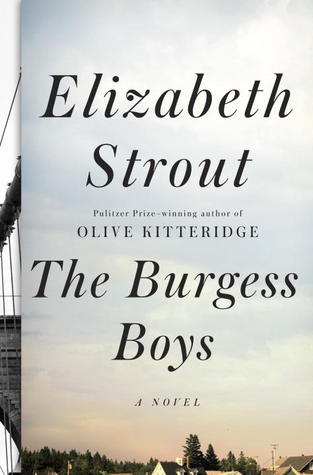
The Burgess Boys

Bibliography
Strout, Elizabeth. The Burgess Boys. New York: Random House, 2013. Print.
image from: http://d202m5krfqbpi5.cloudfront.net/books/1351213545l/15823461.jpg

Plot summary (from the inside cover)
"Haunted by the freak accident that killed their father when they were children, Jim & Bob Burgess escaped from their Maine hometown of Shirley Falls for New York City as soon as they possibly could. Jim, a sleek, successful corporate lawyer, has belittled his bighearted brother their whole lives, and Bob, a Legal Aid attorney who idolizes Jim, has always taken it in stride. But their long standing dynamic is upended when their sister, Susan--the Burgess sibling who stayed behind--urgently calls them home. Her lonely teenage son, Zach, has gotten himself into a world of trouble, and Susan desperately needs their help. And so the Burgess brothers return to the landscape of their childhood, where the long-buried tensions that have shaped and shadowed their relationship begin to surface in unexpected ways that will change them forever."

My Thoughts
My book club picked this book to read. We'd read Strout's Olive Kitteridge, so I was excited to read another story by the same author. 

This is the story of siblings Jim, Bob & Susan Burgess. I wrote my thoughts, and then realized that if you read this blog, you might not have a clear idea of what the book is about, so I included the inside cover description. I'm always afraid to give too much away when I'm writing about a book. Usually my "My Thoughts" section is a personal reaction to what I've read or interesting revelations I saw through the characters. I seem to always learn something from reading a book, whether I liked the story or not. I liked this story.

Bob & Susan are twins. Jim is the older, protective brother. "Your Uncle Jim will take care of you. That's what he does" (Strout 158). Each sibling has a story--a past that has created their present. However, when one sibling confesses that the remembered past is not accurate, each of their lives shift. This is a huge tectonic shift! One truth can change a person.

Strout creates three dimensional characters in a mostly believable story about multiple generations of a family.  What seems like a "slice of life" story actually carries through years. Readers can relate to this story because we all have some degree of dysfunction in our families.  We might not share the same story, but we can relate to the circumstances.

The sub-story that brings the siblings together is that of the awkward teenager Zach . He has done a bone-head act against the Somali community that now lives in his hometown. This act now has him facing federal charges.  Big brother and lawyer Jim will take care of this. He thinks.

I kept thinking about the research Strout must have done to write this story. Who just knows that the Somali people didn't have a written language until 1972 (Strout 130)? There are many layers to the story that would require some research (Somali, parasites, expressions). There was a lot going on in this story (which is divided into four books).  There are several characters that seem minor, but play a pivotal role in the narrative. Nothing is mentioned in the plot summary of Pam, Helen or Steve--the people who married into the Burgess Family. I marked several things the characters did and said. I felt like I visited Shirley Falls, Maine.

I liked the way the story unfolds. It is not predictable. Life isn't. Thanks to Elizabeth Strout for another enjoyable story.

Tuesday, August 20, 2013

Becoming Naomi Leon

Bibliography
Ryan, Pam Munoz. Becoming Naomi Leon. New York: Scholastic, 2004. Print.
image from: http://upload.wikimedia.org/wikipedia/en/8/8e/Becoming_Naomi_Le%C3%B3n.jpg


My Thoughts
Naomi and her brother Owen live with their grandmother in Lemon Tree, California. They get by on simplicity and the power of positive thinking.

Naomi makes lists. She makes lists about what she worries about, interesting words and "Things that were the good and the bad all rolled into one" including the fact that her mother has returned after being gone seven years (Ryan 30). (As a list maker myself, I smiled when I read about this character).

Owen wears tape. It literally holds him together.

The mother made me want to SCREAM! I was so upset about her selfishness and motivations and her treatment of the kids. I don't want to say too much here, but she is below worthless.

The grandmother tries to do her best to help these kids. I admire her tenacity.

When the family travels to Mexico to find Santiago, I was put off by the connections that actually found him. It was much too convenient (however, much needed for the story, I understand. Besides, fiction at this reading level allows for reality to be put aside some). I did like the sprinkling in of the Mexican tradition of radish carving. I don't know if it is true, but it was a glue piece to the story.

I know that this book is a middle grade book, but I don't think I want my daughter to read it yet. There are some people (characters) that I just don't want her to meet. There are some situations that I don't want her to experience. Sadly, there are so many kids that really live like Naomi and Owen. Maybe I should let my daughter read this so that she can experience through reading instead of reality. I will put it on her shelf, and she will find it to read when it is the right time. I believe books "find" us when we can receive the message.

Sunday, August 11, 2013

Insurgent

Bibliography
Roth, Veronica. Insurgent. New York: Katherine Tegen Books, 2012. Print.

image from: http://d202m5krfqbpi5.cloudfront.net/books/1325667729l/11735983.jpg


My Thoughts
This is book two of the Roth trilogy. I am just as pleased with this installment as I was the first book of the story.

Tris is learning that people are not always as they seem and situations are not necessarily right and wrong. She is forced to make tough choices and must learn to decide what to do instead of react and go into situations without being prepared. She says, "I feel like I am collecting the lessons each faction has to teach me, and storing them in my mind like a guidebook for moving through the world" (Roth 411). Yep, that's what growing up is. Each person, each situation, each "life lesson" teaches us, guides us and prepares us. Often, we don't understand at the time, but the revelation comes. As I read this book, I kept thinking of myself and the many lessons I've been taught. I also marked this statement because I thought it tied in to the same idea. "We were all placed here, for a specific purpose" (Roth 487). After finishing the book, I can see the double meaning. I do appreciate Roth's characters and writing.

As I didn't spoil much in the review of Divergent, I also don't want to give away this story. I did mark this statement, though. "I decide to keep the shirt to remind me of why I chose [_____] in the first place: not because they are perfect, but because they are alive. Because they are free" (Roth 418). Tris' revelation is understandable.

When some plans are being made in Chapter 38, I kept thinking of Animal Farm. It is easy to feel right when everyone agrees with you. However, just because everyone agrees doesn't make an action right.

The title reference is on page 509. "Insurgent. Noun. A person who acts in opposition to the established authority, who is not necessarily regarded as a belligerent." I wondered when I would see it. The end of the book just leads us into the third book that comes out this fall. I CAN'T WAIT TO READ IT!

Friday, August 2, 2013

Divergent

Bibliography
Roth, Veronica. Divergent. New York: Katherine Tegen Books, 2011. Print.
image from: http://www.hollywoodreporter.com/sites/default/files/2012/09/divergent_veronica_roth_a_p.jpg


My Thoughts
Oh, I enjoyed this book! This is a dystopian novel set in Chicago. There are five factions. What I found as I read this book, that we all are, in part, these five factions. Roth has pinpointed human nature and created an interesting story about what happens when the five factions interact with each other. "Without a faction, we have no purpose and no reason to live" (Roth 15).

The Five Factions
  • Abnegation (values selflessness)
  • Candor (values honesty)
  • Dauntless (values courage)
  • Erudite (values knowledge)
  • Amity (values understanding)
Beatrice is Abnegation. She is supposed to be selfless. After she turns 16, she must choose which faction she will live with for the rest of her life. "I will decide to stay with my family or abandon them" (Roth 5). She chooses...

I don't want to say much about the book because it is SO good, and I want the reader to uncover the story. The title reference is on page 16 (and appears elsewhere in the book), and that fits in to the story. Again, I don't want to spoil it here.

One thing I enjoyed about this book is how I began looking at people (I was in Boston at the time of reading) and "assigning" them to the five factions. I even labeled myself as I recognized the faction traits.

I'm excited to learn that this book is coming out in movie form next March. I hope it will be good. I've started reading the second book in the series, Insurgent and the third title comes out this fall. I can't wait to recommend this book to my students. It is clean (a kissing scene does appear on page 182) and not too futuristic that it isn't possible to imagine. However, there are some violent things that happen.

Thursday, July 18, 2013

Fenway: A Fascinating First Century

Bibliography
Bauer, David, ed. Fenway: A Fascinating First Century. New York: Sports Illustrated Books, 2012. Print.
image from: http://s1.dmcdn.net/Zpbf/x240-1hg.jpg

My Thoughts
As one of my life-long goals is to see Fenway, this book was very exciting to read. Well, there actually isn't too much text---a few essays from Sports Illustrated writers and many photo captions.

The opening pages explain the history of the ballpark (It opened April 20,1912.) and how through the years it has survived demolition, renovation and the curse of not winning pennants. Then the book is broken into a timeline that includes historical events along with the happenings of the park and players that took the field.

The pictures are amazing! It was fun to read about players who once donned the Red Sox jersey and to see the park evolve with the changing times. As many of the essays were written before this book was compiled, the predictions and exclamations made by the writers and players are an interesting piece of history (and fun to see if they came true).

The cutest thing was at the end of the book in the chapter entitled "Little Fenways." Here, the editor compiled various examples of Fenway replications, including a Lego ballpark. Cute, cute, cute!

The last pages of the book are 100 factoids and tidbits related to Fenway Park. Super interesting, especially for the stat loving fan.

I'm leaving tomorrow to see this majestic field. This book absolutely put a spark in my heart, and I can't wait to compare the images from the book to the live stadium!

Tuesday, July 16, 2013

The Book Thief

Bibliography
Zusak, Markus. The Book Thief. New York: Alfred A. Knopf, 2005. Kindle file.
image from:  http://blog.swagbucks.com/wp-content/uploads/2013/06/The-Book-Thief-194x300.jpg

My Thoughts

The narrative voice that starts this story is first person death. This is an interesting choice, as death travels to all places at all times, especially during a war.

The narrative voice introduces the reader to Liesel Meminger, the book thief. Death sees the colors of red, white and black when he thinks of her. He tells us her story. Most of the story takes place between 1939-1943. Hitler is rising in power and Germany is changing. Jews are being rounded up and sent away.

The narrative voice interjects observations, notes, and information to help the reader understand more of the story and also drops clues of what is to come. The narrative voice has a wry sense of humor.
It made me laugh on more than one occasion. I enjoyed the side notes he provided. For example, "I do not carry a sickle or scythe. I only wear a hooded black robe when it's cold. And I don't have those skull-like facial features you seem to enjoy pinning on me from a distance" (Zusak). 

Liesel is taken to the Hubermanns for foster care. Her mother can no longer care for her, her father (a Communist) is gone and her brother is dead. Rosa Hubermann is strict,  has "a distinct waddle to her walk" and cusses quite a lot (Zusak). She does washing for other families. Hans is quiet, paints, plays the accordion and rolls his own cigarettes. They ask Liesel to call them Mama and Papa.

The irony of Liesel being the book thief is that she cannot read. Hans tries to help her and is a comfort to her young soul. He is gentle and caring--quite the opposite of his wife Rosa. "If I ever ask you to keep a secret for me, you will do it" Hans says. Liesel promises she will. The secret is learned and kept.

"She was a girl. In Nazi Germany. How fitting that she was discovering the power of words" (Zusak).
The events and characters in the story are intertwined. Often things are seen, but not seen. This is how we live. We don't always see the connections. Enemies are actually friends. Lessons are repeated.

This book has many characters, many poignant moments, many historical elements, many surprises and many lessons about humanity that makes it a good read. It's hard to talk about the book with any satisfaction. It must be read and experienced.

 
The following are notes I took while reading. As I think the book must be experienced, I also didn't want to forget these things, so I'm leaving them on the blog. Don't read these until you read the book. You will be disappointed to learn what happens from my notes.


***************characters
Rudy Steiner becomes Liesel's best friend and ally. "In years to come, he would be a giver of bread, not a stealer--proof again of the contradictory human being. So much good, so much evil. Just add water" (Zusak).

Hans Junior--son, Nazi. He calls his father a coward. His story will tragically end in Stalingrad, Russia.
Trudy/Trudel-daughter. housemaid

Ilsa Hermann, mayor's wife, allows her in to library
books belong to Johann Hermann--her son, died 1918

Arthur Berg-apple, food thief
Viktor Chemmel-leads thief gang

*************things happening
Max Vandenburg is hiding---goes to Hubermann's--Max's dad (Erik Vandenburg--taught him to play the accordion) actually saved Hans in Great War--volunteers for handwriting. "That was the first time Hans Hubermann escaped me. ...Not many men are lucky enough to cheat me twice" (Zusak).

Walter Kugler helps Max (they use to fight each other--in that became friends)

"Do you still play the accordion?" = "Will you still help me?"

Viktor throws The Whisperer in the river--Rudy retrieves it

Max is sick--brought up to Liesel's bed--after snowman in basement--Liesel starts bringing him gifts (flattened ball, ribbon, pinecone, button, stone, feather, two newspapers, candy wrapper, cloud "Memorize it. Then write it down for him" (Zusak). toy soldier, miraculous leaf, finished whistler, slab of grief)

Liesel steals 2nd book from mayor's library The Dream Carrier
Max wakes up!

Bombing takes Himmel Street--except Liesel who is reading in the "too shallow" basement

Liesel finds Max in "parade" through town--she is whipped by soldier, too
Liesel tells Rudy story of Max

Ilsa Hermann tells Liesel to write if she can't read any more words (Liesel destroyed book)

back to bombing--kissed Rudy (he's already dead)
holds Mama's hand and talks to her; can't look at Papa. gets his accordion for him

death picks up Liesel's book

"Liesel Meminger lived to a very old age"--Ilsa and husband pick her up at police station

Alex Steiner comes back--Liesel spends time with him in the shop; Max returns!

Death says "I am haunted by humans"