Monday, February 1, 2016

The Amish

Bibliography
Kraybill, Donald, Karen M. Johnson-Weiner, Steven M. Nolt. The Amish. Baltimore, The John Hopkins University Press, 2013. Print.

image from: amazon.com

My Thoughts
This non-fiction book was fascinating and well researched and over 400 pages in length. I took lots of notes and flagged so many pages while reading. This was almost like reading several academic papers (Each chapter is a different aspect of Amish life.) that the researchers wrote. "Our goal is to tell the Amish story with the resources of solid scholarship in a style that appeals not only to scholars but also to a broader audience interest in the Amish experience" (Kraybill xiii). I think they accomplish this goal. I flipped to the appendix and read the footnotes (which is partly why it took several weeks to read this!) when I came to them in the text. Pictures, graphs, tables and maps add to the book. At the end of each chapter, the writers included a summary paragraph. This just reiterates the focus of the chapter.

I appreciated that the authors contend beginning in the preface that this book cannot possibly describe ALL Amish--some generalizations are made while trying to be respectful of all Amish sects. "It is hazardous to speak of 'The Amish' as if they were one unified group" (Kraybill 13). When people say "Amish" we often have a preconceived notion (stereotypes) that ALL Amish do this, wear that, don't use certain technologies, etc. The movies and television have done much to perpetuate this idea. I was honestly surprised to learn that one Amish lady was actually a Mary Kay beauty consultant and several were Pampered Chef consultants (Kraybill 305). Some Amish have organic farms/cooperatives, small home based businesses and many work for the "English." The "mystique of Amish life creates a branding effect..." (Kraybill 305). As non-Amish, we are curious about this group because they are different. They "'represent a way of life we wish we could live'" (qtd. in Kraybill 397).

The opening chapter explains the roots of the Amish community, but I'm still unclear on how the Mennonites and Amish are kinda related going back to the beginning, but they are different in their practice of religion and aspects of lifestyle (Kraybill 26).

Most Amish follow the Ordnung--the stable, tradition-guided moral order (Kraybill 41).
In the chapter about population patterns, my hometown of Stephenville was mentioned (Kraybill 183). I do remember when I first moved here, I would see black horse-drawn buggies going down the road. Even the place that I worked had a "hitching post" in the parking lot until just a few years ago.

There are aspects of the Amish lifestyle that I think are universal--live simple lives, try to do your best, honor your elders and pursue a measure of happiness. This "Gelassenheit is the deep taproot that nourishes the Amish way. A German word that resists easy translation, it roughly means 'calmness, acceptance, and yieldedness'...'let go, quit trying to figure it out, let it alone'" (Kraybill 98). The Gelassenheit has five dimensions: personality, symbols, structure, values, & rituals. A graphic is included on page 99 to show how these areas include all aspects of Amish life.

In the "Symbols and Identity" chapter, the writers show that the Amish do not all dress alike. Their dress performs different tasks and signal different meanings within the culture. The seven social tasks that dress performs:

  1. signals that a member has yielded to the collective order,
  2. it prevents dress from being used for self-adornment,
  3. it promotes equality,
  4. it creates a common consciousness that bolsters group identity,
  5. it encourages members to "act Amish,"
  6. it projects a united public front, which conceals diversity in other areas,
  7. it erects symbolic boundaries around the group. (Kraybill 127). 
The style and color of dress signify social distinctions linked to at least ten dimensions of Amish life: 
  1. gender, 
  2. age,
  3. marital status, 
  4. compliance, 
  5. church membership,
  6. social esteem, 
  7. religious rituals, 
  8. rites of passage, 
  9. sacred-profane boundaries, 
  10. ethnic-public domains. (Kraybill 128)

Chapter Twelve was entitled "From Rumspringa to Marriage" which is where several myths about the Amish were dispelled. The concept of Rumspringa is defined as "a time to find a mate" rather than "explore the outside world" (Kraybill 214). I didn't realize this. I've always heard and believed that Amish teenagers were encouraged to go out, explore and then decide to stay in or go out of the community. Rumspringa is so much more (and is better explained later in the chapter by the authors).

The end of Chapter 13 was about Amish funerals. I read this the same day I learned of my Aunt Martha's death.

Chapter 14 was about Amish education, which is a very controversial topic between the English and the Amish. Usually, Amish children only go through 8th grade and are not taught critical or reflective thinking. They are taught "a basic education for the entrepreneurs...and gives those who leave the Amish world a solid set of employable skills in the public job market" (Kraybill 270). Amish children are not usually home schooled, as "schools socialize students for adult life in a collective ethnic community" (Kraybill 267). I found this very interesting.

Another chapter I found very interesting was "The Amish in Print" (Chapter 20) where I learned more about the Amish publishing house and the idea of "Amish romance novels" or 'bonnet fiction' as its own genre.

Did you know...?
  • Amish faith focuses more on how one lives than on what one believes (Kraybill 65)
  • Amish clergy receive no compensation, formal education and serve for life (unless an illness) (Kraybill 92)
  • Many liberal Amish read mainstream Christian authors such as Karen Kingsbury, Francine Rivers and Janette Oke (Kraybill 112)
  • Some Amish "trick out" their buggies (which made me laugh thinking about that) (Kraybill 131). 
  • There is an Amish publishing house (Pathway Publishers) 
  • Until a person actually joins the church (usually late teens/early 20s after Rumspringa), they are not shunned if they choose not to join the church
  • Amish weddings are usually held on weekdays, in the house, shop or other buildings at the home of the bride or a relative. There is no rehearsal, photographs, gowns, veils, rings or tuxedos, and the ceremony lasts five minutes at the end of a three hour church service (in which about forty minutes of this service is the couple meeting privately with the minister while the guests/congregation sings several hymns) (Kraybill 233)
  • Many Amish business rely on China to make products
  • Most Amish farms are not organic (Kraybill 285)
  • Amish and non-Amish foods are identical (Kraybill 394)--this made me laugh!
  • The Amish do not observe Advent or Lent (Kraybill 86)
  • Almost no Amish serve as individual missionaries or aid workers due to air travel being prohibited (Kraybill 366)    
I'm glad I invested the time to read this book. It was fascinating to learn about the Amish as a whole.  


Saturday, January 2, 2016

The Last Forever

Bibliography
Caletti, Deb. The Last Forever. New York: Simon Pulse, 2014. Print.

image from: www.debcaletti.com

Plot Summary (from inside book jacket)
Nothing lasts forever, and no one gets that more than Tessa. After her mother died, it's all she can do to keep her friends, her boyfriend, her happiness from slipping away. And then there's her dad. He's stuck in his own daze, and it's so hard to feel like a family when their house no longer seems like a home.

Her father's solution? An impromptu road trip that lands them in a small coastal town, at Tessa's grandmother's. Despite all the warmth and beauty there, Tessa can't help but feel even more lost.

Enter Henry Lark. He understands the relationships that matter. And more important, he understands her. A secret stands between them, but Tessa's willing to do anything to bring them together--because Henry may just be her one chance at forever.

My Thoughts
I was surprised by this book. The story is not exactly what I thought it would be. I expected a mushy, gushy love story. What I got was a humorous read that did have a hint of love, but it was also a bigger story of human love--love between generations--love between friends--love as encouragement.

Caletti hooked me early in the book when she describes the hotel that Tess and her father stay at on their road trip. This humor and wit fill the pages.
We stay at the Piney Woods Lodge. The name makes you think of stone fireplaces and stuffed elk heads and downy beds, but it is actually one of those two-leveled motels you see in movies where someone always OD's. No one ever OD's in a La Quinta in the movies. It's always these places with windows looking out onto a parking lot and gold room numbers on the doors. 
Well, of course, it smells like cigarettes in there. Not a recent cigarette, but one that was smoked sometime in the 1970s. (Caletti 26)
This made me laugh out loud. I even read it to my husband (trying to get through the description while laughing) because I found it so funny (and so true!).

I must confess that I was swayed a bit to like this book because Caletti writes about a library in a most favorable way (and it's an important setting piece of the story). I love her description early in the book. When Tess finds the Parrish Island Library, "Relief washes over me. I love the library. I have always felt safe in the library. It's like seeing the entrance of a church. I want to set myself down there like an abandoned baby in a basket" (Caletti 56).  On one visit, Tess says while at the library, "the quiet, the soft chair--take me in and give me comfort. I'm surrounded by stories and answers and years and years of volumes of the right words....That great musty smell of the library speaks of solid, timeless things, old and lasting ones" (Caletti 60). However, Caletti's description that I enjoyed the most was when Tess explains:
Usually I set one foot in a library and I feel my own internal volume lower. A library is a physical equivalent of a sigh. It's the silence, sure, but it's also the certainty of all those books, the way they stand side by side with their still, calm conviction. It's the reassurance of knowledge in the face of confusion. But now, even in my most favorite calm place, my heart is like a racehorse. (Caletti 85)
I feel a little like this each morning when I go to work. Of course, I appreciated the nod to librarians everywhere when one character says, "never underestimate a determined librarian" (Caletti 239).

Each chapter starts with information about a different plant. I thought about how much research Caletti must have done to include this. I also wondered if she is an avid gardener? or is the information even true? I quickly saw the parallel to keeping plants alive is akin to people. This advice reminded me of Sue Monk Kidd's book The Secret Life of Bees. 

There are many relationships in this book. The story opens with a father/daughter road trip, but then layers are added. New friendships are formed. Dreams are realized. It is believable. I liked when
one character explains that, "every person's story is either a little crazy or a lot crazy" (Caletti 129). Yep, and we need to realize that at certain times of our lives, the level of crazy changes.

The title reference is on page 206, 235, & 277.

Friday, December 18, 2015

Red Queen

Bibliography
Aveyard, Victoria. Red Queen. New York: Harper Teen, 2015. Print.

image from: victoriaaveyard.com

My Thoughts
I'd been seeing this beautiful cover through several library world things. I put it on my "to read" pile and my first order of the year.

I made time for it this month, bumping other books that should probably be read first. I just couldn't wait any longer. SO HAPPY I READ IT and now I'm disappointed that I'll have to wait until February for the next installment.

The writing is vivid. The story is believable. There are some cliches, stereotypes and "fantastical" elements, but this was a fresh spin on an old story. I really got lost in the story. I could envision the scenery and the action. In parts of the book, I thought of Game of Thrones, especially when the Silver houses are described. Each has a specific color and personality.

Mare Barrow is a Red. She is not a Silver. Silvers have all the power, wealth and supernatural ability. However, Mare has a power, one she didn't know she had until an accident brought it out of her. She then is "forced into being someone else. Into being one of them. A puppet. A show to keep people happy, quiet, and trampled" (Aveyard 86).

"Strength and power are the words Cal has been raised to know. Not goodness. Not kindness. Not empathy or bravery or equality or anything else that a ruler should strive for" (Aveyard 151). At least, this is what Mare first thinks.  As the story moves, I think she sees and learns more about Cal.

Queen Elara is someone you love to hate. I'm sure she will be a big part of the second book.

Trying not to compare GOT to this book too much, but Maven reminds me of King Joffrey. I wanted to like him, but there was something nagging at me about him. Mare realizes, "he was too perfect, too brave, too kind...he gave me exactly what I wanted, and it made me blind" (Aveyard 339).

If I were borrowing an idea from another book (Everything, Everything), the Life Is Short Spoiler Reviews would be "A forgotten son, a vengeful mother, a brother with a long shadow, a strange mutation. Together, they've written a tragedy" (Aveyard 355).

Quite a twist happens in the Epilogue. Come on, February! Glad I pushed this book up on the pile.

The title reference is on pages 268, 354. I think there's even a book cover reference on page 303.

Thursday, December 17, 2015

Go Set a Watchman

Bibliography
Lee, Harper. Go Set a Watchman.
image from: www.amazon.com
Image result for go set a watchman amazon
My Thoughts
I have serious doubts about whether or not Harper Lee actually wrote this book. I think she probably wrote some of it, but it just doesn't sound like be same narrative voice used in To Kill a Mockingbird.

Unfortunately I didn't get to discuss this book with my book club to hear if they thought the same. 

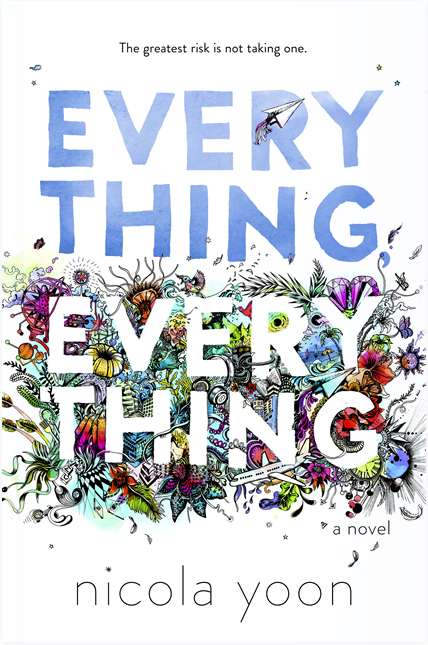
Everything, Everything

Bibliography
Yoon, Nicola. Everything, Everything. New York: Delacorte Press, 2015. Print.

image from: www.nicolayoon.com
book_cover.jpg
My Thoughts
I really enjoyed reading this book! In fact, I added it to my "books I really enjoyed" list on the homepage of this blog. This was an ARC (advanced reader copy) that I got at TLA this year. I'm happy to be reading current books instead of years after they are published.

The premise is interesting and the story throughout stays true to the premise. To me, this story could be an applied metaphor for all of our lives. There are several "ah ha" moments and things I flagged. I enjoyed studying the cover (the juxtaposition of the two words and the accompanying art work or lack of art) as I read. It made more sense.

Madeline is sick--allergic to the world to be exact. Her house is a no germ zone. She cannot leave and very few people will endure the decontamination process to enter.  Then the mysterious "new guy" moves in next door. She sees him. He sees her. They communicate through the windows. Then the emails begin. Olly is his name. He's got a funny sense of humor. I often laughed at his antics.  He sends her pictures of his school, including the "library and librarian who looks exactly as I imagine a high school librarian would, which is to say bookish and wonderful" (Yoon 155). LOVE IT!

Since Madeline can't experience life for herself, she reads. A LOT! I loved her "Life is Short Spoiler Reviews" about the books.

  • Flowers for Algernon- A is a mouse. The mouse dies.
  • Lord of the Flies-Boys are savages. (Timely reference since I just listened to this book over the summer). 
  •  Alice's Adventures in Wonderland-Beware the Queen of Hearts. She'll have your head.
  • Invisible Man-You don't exist if no one can see you. 
  • The Stranger, Waiting for Godot, Nausea-Everything is nothing.
  • The Little Prince-Love is worth everything. Everything.

This book not only blends formats (narration with email and screen shots), there are also great illustrated drawings (done by the author's husband) that supplement the story. Truly, when I finished this book, I was delighted--not that it was over but because I had experienced the story.

This is a book I will share with my teens. WARNING: There is a sex scene (you'll see how this is possible when you read it).

Monday, December 7, 2015

Everybody Sees the Ants


Bibliography
King, A. S. Everybody Sees the Ants. New York: Little, Brown & Company, 2011. Print.

image from: www.goodreads.com

Plot Summary (from inside cover)

"Lucky Linderman doesn't want to wake up...Lucky Linderman didn't ask for his life. He didn't ask his grandfather not to come home from the Vietnam War. He didn't ask for a father who never got over it. He didn't ask for a mother who keeps pretending their dysfunctional family is fine. And he didn't ask to be the target of Nader McMillan's relentless bullying, which has finally gone too far.

But Lucky has a secret--one that helps him wade through the daily mundane torture of his life. In his dreams, Lucky escapes to the war-ridden jungles of Laos--the prison his grandfather couldn't escape--where Lucky can be a real man, an adventurer, and a hero. It's dangerous and wild, and it's a place where his life just might be worth living. But how long can Lucky keep hiding in his dreams before reality forces its way inside?"

Image result for everybody sees the ants
My Thoughts
I can't remember now how I first heard of this story and put this in my "to read pile." A.S. King touches on a few topics, but the biggest is about bullying-- a topic I wrestle with helping my teens--so I moved it "up" on the pile.

The story follows Lucky Linderman's life. He has been bullied since he was 7 years old by Nader McMillan. The latest incident sends him and his mother to stay with his uncle and aunt in Arizona. Staying with them was quite an experience. Aunt Jodi is C.R.A.Z.Y. crazy! Uncle Dave tries to mentor Lucky, but Dave has his own secrets.

The ants do play a part in Lucky's imagination. He first finds them in his jungle dreams, where he tries to save his grandfather. Later, he sees the ants reacting to the people in Lucky's life. The ants provide a bit of comic relief, and I found that the ants and I often agreed.

Another thing I found funny was the scab on Lucky's face. As the story progresses, the shape of the scab changes. It begins looking like Ohio, changing to West Virginia, the hand part of Michigan, Iowa, Pennsylvania, Massachusetts, and finally Hawaii. I could visualize the changing shape.

Lucky meets Ginny, a girl who is a night ninja. (Read the book--this will make sense). There is a wonderful analogy that tie Lucky & Ginny together. "That's the perfect way to explain how I feel about everything in the world. I don't even use the stupid shampoo" (King 219). Again,  read the book.

When Lucky and his family go to the Grand Canyon, I knew his description was true. "It really is the most mind-blowing thing I've ever seen...All we can say is 'wow'" (King 153).

The book is divided into three parts. The title reference appears on page 243. Lucky addresses the reader by starting some chapters with "___ thing you need to know." There are 12 things the reader needs to know.

The book doesn't offer answers or try to preach about bullies, even though I recognize many "answers" the adults try to give Lucky. The story shows how bullying can sometimes occur over years, and how it manifests in different relationships. In one part of the story, Lucky says, "It occurs to me that...we'd be like a folded map of America...I wonder, then, how many other kids could join in. Where are the Montanas and the Colorados? Where is Vermont? Florida? How many maps could we make?" (King 241).

The ending is hopeful. Lucky realizes he'll have to be the change he wants. He starts by eating what his dad cooked and finally saying goodbye to his granddad in his dreams.

Thursday, December 3, 2015

Lord of the Flies

Bibliography
Golding, William. Lord of the Flies. Read by William Golding. Penguin Random House Audio Publishing Group, 2003. Audiobook.

image from: www.amazon.com
Product Details
Plot Summary 
British schoolboys are stranded on a tropical island. In an attempt to recreate the culture they left behind, they elect Ralph to lead, with the intellectual Piggy as counselor. But Jack wants to lead, too, and one-by-one, he lures the boys from civility and reason to the savage survivalism of primeval hunters. In Lord of the Flies, William Golding gives us a glimpse of the savagery that underlies even the most civilized human beings.

The three most important aspects of Lord of the Flies:
  • The major theme of Lord of the Flies is that humans are essentially barbaric if not downright evil. The stranded boys begin by establishing a society similar to the one they left behind in England, but soon their society has degenerated into rival clans ruled by fear and violence; before the book is over, three boys have been killed.
  • The novel is an allegory, which is a story in which characters, settings, and events stand for things larger than themselves. For example, the island represents the world; Ralph and Jack symbolize different approaches to leadership.
  • William Golding wrote Lord of the Flies following World War II, during which the Nazis exterminated six million Jews and the United States dropped two atomic bombs on Japan. In this context, the novel's profound pessimism is understandable.
My Thoughts

I've heard about this book for years, as my Senior English teacher friends teach this book. It is one I've never stopped to read, so when it was available as a free audiobook, I was excited to get it.

I listened to this book on the way home from South Dakota this summer. The narrator's voice was the author! I thought that was neat. His pauses, pronounciations and inflections are still in my head.  I remember driving through Kansas imagining the island the boys lived on in this book.

Piggy was the voice of rational thoughts. He tried to keep the island calm, but he was pushed aside by Jack's quest for leadership and power. It made me sad to hear what happened to him.

Ralph was also a character I came to care about in this story. He was trying to do the "right thing" and when the boys are finally found, he cries. I almost cried, too. It was a very moving scene.

As I was driving (and it's been a few months since listening), I can't remember what else happened. I remember a waterfall and again, just listening to the author's voice read the story. This will probably be a story I actually pick up the book to read to help me remember more.