Friday, December 18, 2015

Red Queen

Bibliography
Aveyard, Victoria. Red Queen. New York: Harper Teen, 2015. Print.

image from: victoriaaveyard.com

My Thoughts
I'd been seeing this beautiful cover through several library world things. I put it on my "to read" pile and my first order of the year.

I made time for it this month, bumping other books that should probably be read first. I just couldn't wait any longer. SO HAPPY I READ IT and now I'm disappointed that I'll have to wait until February for the next installment.

The writing is vivid. The story is believable. There are some cliches, stereotypes and "fantastical" elements, but this was a fresh spin on an old story. I really got lost in the story. I could envision the scenery and the action. In parts of the book, I thought of Game of Thrones, especially when the Silver houses are described. Each has a specific color and personality.

Mare Barrow is a Red. She is not a Silver. Silvers have all the power, wealth and supernatural ability. However, Mare has a power, one she didn't know she had until an accident brought it out of her. She then is "forced into being someone else. Into being one of them. A puppet. A show to keep people happy, quiet, and trampled" (Aveyard 86).

"Strength and power are the words Cal has been raised to know. Not goodness. Not kindness. Not empathy or bravery or equality or anything else that a ruler should strive for" (Aveyard 151). At least, this is what Mare first thinks.  As the story moves, I think she sees and learns more about Cal.

Queen Elara is someone you love to hate. I'm sure she will be a big part of the second book.

Trying not to compare GOT to this book too much, but Maven reminds me of King Joffrey. I wanted to like him, but there was something nagging at me about him. Mare realizes, "he was too perfect, too brave, too kind...he gave me exactly what I wanted, and it made me blind" (Aveyard 339).

If I were borrowing an idea from another book (Everything, Everything), the Life Is Short Spoiler Reviews would be "A forgotten son, a vengeful mother, a brother with a long shadow, a strange mutation. Together, they've written a tragedy" (Aveyard 355).

Quite a twist happens in the Epilogue. Come on, February! Glad I pushed this book up on the pile.

The title reference is on pages 268, 354. I think there's even a book cover reference on page 303.

Thursday, December 17, 2015

Go Set a Watchman

Bibliography
Lee, Harper. Go Set a Watchman.
image from: www.amazon.com
Image result for go set a watchman amazon
My Thoughts
I have serious doubts about whether or not Harper Lee actually wrote this book. I think she probably wrote some of it, but it just doesn't sound like be same narrative voice used in To Kill a Mockingbird.

Unfortunately I didn't get to discuss this book with my book club to hear if they thought the same. 

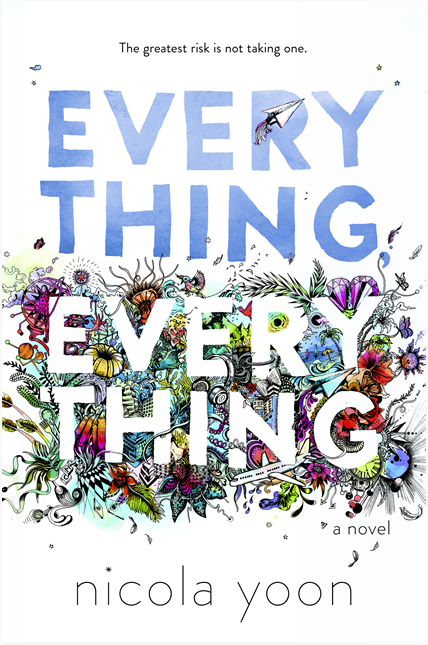
Everything, Everything

Bibliography
Yoon, Nicola. Everything, Everything. New York: Delacorte Press, 2015. Print.

image from: www.nicolayoon.com
book_cover.jpg
My Thoughts
I really enjoyed reading this book! In fact, I added it to my "books I really enjoyed" list on the homepage of this blog. This was an ARC (advanced reader copy) that I got at TLA this year. I'm happy to be reading current books instead of years after they are published.

The premise is interesting and the story throughout stays true to the premise. To me, this story could be an applied metaphor for all of our lives. There are several "ah ha" moments and things I flagged. I enjoyed studying the cover (the juxtaposition of the two words and the accompanying art work or lack of art) as I read. It made more sense.

Madeline is sick--allergic to the world to be exact. Her house is a no germ zone. She cannot leave and very few people will endure the decontamination process to enter.  Then the mysterious "new guy" moves in next door. She sees him. He sees her. They communicate through the windows. Then the emails begin. Olly is his name. He's got a funny sense of humor. I often laughed at his antics.  He sends her pictures of his school, including the "library and librarian who looks exactly as I imagine a high school librarian would, which is to say bookish and wonderful" (Yoon 155). LOVE IT!

Since Madeline can't experience life for herself, she reads. A LOT! I loved her "Life is Short Spoiler Reviews" about the books.

  • Flowers for Algernon- A is a mouse. The mouse dies.
  • Lord of the Flies-Boys are savages. (Timely reference since I just listened to this book over the summer). 
  •  Alice's Adventures in Wonderland-Beware the Queen of Hearts. She'll have your head.
  • Invisible Man-You don't exist if no one can see you. 
  • The Stranger, Waiting for Godot, Nausea-Everything is nothing.
  • The Little Prince-Love is worth everything. Everything.

This book not only blends formats (narration with email and screen shots), there are also great illustrated drawings (done by the author's husband) that supplement the story. Truly, when I finished this book, I was delighted--not that it was over but because I had experienced the story.

This is a book I will share with my teens. WARNING: There is a sex scene (you'll see how this is possible when you read it).

Monday, December 7, 2015

Everybody Sees the Ants


Bibliography
King, A. S. Everybody Sees the Ants. New York: Little, Brown & Company, 2011. Print.

image from: www.goodreads.com

Plot Summary (from inside cover)

"Lucky Linderman doesn't want to wake up...Lucky Linderman didn't ask for his life. He didn't ask his grandfather not to come home from the Vietnam War. He didn't ask for a father who never got over it. He didn't ask for a mother who keeps pretending their dysfunctional family is fine. And he didn't ask to be the target of Nader McMillan's relentless bullying, which has finally gone too far.

But Lucky has a secret--one that helps him wade through the daily mundane torture of his life. In his dreams, Lucky escapes to the war-ridden jungles of Laos--the prison his grandfather couldn't escape--where Lucky can be a real man, an adventurer, and a hero. It's dangerous and wild, and it's a place where his life just might be worth living. But how long can Lucky keep hiding in his dreams before reality forces its way inside?"

Image result for everybody sees the ants
My Thoughts
I can't remember now how I first heard of this story and put this in my "to read pile." A.S. King touches on a few topics, but the biggest is about bullying-- a topic I wrestle with helping my teens--so I moved it "up" on the pile.

The story follows Lucky Linderman's life. He has been bullied since he was 7 years old by Nader McMillan. The latest incident sends him and his mother to stay with his uncle and aunt in Arizona. Staying with them was quite an experience. Aunt Jodi is C.R.A.Z.Y. crazy! Uncle Dave tries to mentor Lucky, but Dave has his own secrets.

The ants do play a part in Lucky's imagination. He first finds them in his jungle dreams, where he tries to save his grandfather. Later, he sees the ants reacting to the people in Lucky's life. The ants provide a bit of comic relief, and I found that the ants and I often agreed.

Another thing I found funny was the scab on Lucky's face. As the story progresses, the shape of the scab changes. It begins looking like Ohio, changing to West Virginia, the hand part of Michigan, Iowa, Pennsylvania, Massachusetts, and finally Hawaii. I could visualize the changing shape.

Lucky meets Ginny, a girl who is a night ninja. (Read the book--this will make sense). There is a wonderful analogy that tie Lucky & Ginny together. "That's the perfect way to explain how I feel about everything in the world. I don't even use the stupid shampoo" (King 219). Again,  read the book.

When Lucky and his family go to the Grand Canyon, I knew his description was true. "It really is the most mind-blowing thing I've ever seen...All we can say is 'wow'" (King 153).

The book is divided into three parts. The title reference appears on page 243. Lucky addresses the reader by starting some chapters with "___ thing you need to know." There are 12 things the reader needs to know.

The book doesn't offer answers or try to preach about bullies, even though I recognize many "answers" the adults try to give Lucky. The story shows how bullying can sometimes occur over years, and how it manifests in different relationships. In one part of the story, Lucky says, "It occurs to me that...we'd be like a folded map of America...I wonder, then, how many other kids could join in. Where are the Montanas and the Colorados? Where is Vermont? Florida? How many maps could we make?" (King 241).

The ending is hopeful. Lucky realizes he'll have to be the change he wants. He starts by eating what his dad cooked and finally saying goodbye to his granddad in his dreams.

Thursday, December 3, 2015

Lord of the Flies

Bibliography
Golding, William. Lord of the Flies. Read by William Golding. Penguin Random House Audio Publishing Group, 2003. Audiobook.

image from: www.amazon.com
Product Details
Plot Summary 
British schoolboys are stranded on a tropical island. In an attempt to recreate the culture they left behind, they elect Ralph to lead, with the intellectual Piggy as counselor. But Jack wants to lead, too, and one-by-one, he lures the boys from civility and reason to the savage survivalism of primeval hunters. In Lord of the Flies, William Golding gives us a glimpse of the savagery that underlies even the most civilized human beings.

The three most important aspects of Lord of the Flies:
  • The major theme of Lord of the Flies is that humans are essentially barbaric if not downright evil. The stranded boys begin by establishing a society similar to the one they left behind in England, but soon their society has degenerated into rival clans ruled by fear and violence; before the book is over, three boys have been killed.
  • The novel is an allegory, which is a story in which characters, settings, and events stand for things larger than themselves. For example, the island represents the world; Ralph and Jack symbolize different approaches to leadership.
  • William Golding wrote Lord of the Flies following World War II, during which the Nazis exterminated six million Jews and the United States dropped two atomic bombs on Japan. In this context, the novel's profound pessimism is understandable.
My Thoughts

I've heard about this book for years, as my Senior English teacher friends teach this book. It is one I've never stopped to read, so when it was available as a free audiobook, I was excited to get it.

I listened to this book on the way home from South Dakota this summer. The narrator's voice was the author! I thought that was neat. His pauses, pronounciations and inflections are still in my head.  I remember driving through Kansas imagining the island the boys lived on in this book.

Piggy was the voice of rational thoughts. He tried to keep the island calm, but he was pushed aside by Jack's quest for leadership and power. It made me sad to hear what happened to him.

Ralph was also a character I came to care about in this story. He was trying to do the "right thing" and when the boys are finally found, he cries. I almost cried, too. It was a very moving scene.

As I was driving (and it's been a few months since listening), I can't remember what else happened. I remember a waterfall and again, just listening to the author's voice read the story. This will probably be a story I actually pick up the book to read to help me remember more.

Thursday, November 19, 2015

Conviction

Bibliography
Gilbert, Kelly Loy. Conviction. Hyperion: Los Angeles, 2015. Print.
image from: www.goodreads.com

My Thoughts
I got this ARC (Advanced Reader Copy) at library conference this year. It was one of the first things I wanted to read from this year's haul. It sounded like a great story and was getting some good buzz on Twitter. However, after reading it, I was disappointed. I wanted a lot more from this book. There is a lot happening in this book, but it just didn't come together for me.

The story started great--there was a baseball connection (even though I found a pretty big error about the game on page 49). From the opening pages, I was ready and intrigued.

Braden Raynor plays baseball. When his dad, a radio personality, is arrested for a hate crime, the characters' stories begin to unfold. However, the dad's story is never really explained. I understand that the boy is the main character, but I needed more about the dad. The story dropped hints that there was more to him, yet at the end of the the book, he was still pretty one dimensional. He is mean, aggressive and drinks. His own dad committed suicide  I wanted the dad's mystery explained. There are glimpses into who he is and what possibly (or actually) happened, but it seemed like there was more to say about him that wasn't.

(On a side note, I read this book shortly after watching American Crime Story, a story starring Felicity Huffman & Timothy Hutton, that centers on a hate crime. I thought the timing was ironic).

There was a lot of cussing and "f bombs" dropped in the story that was off-putting. Wasn't this supposed to be "Christian fiction?" There are many references to God's grace and faith, even a few scriptures used, but it often seemed either preachy or flippant.

Braden's older brother Trey came to stay with him while the dad was incarcerated. I wondered would he really give up his life to stay with a brother he hardly knows in the house he left years ago? This didn't seem believable to me. I guessed pretty early in the book that Trey was gay. This side story offered some mystery to the overall story. Why did Trey leave home? What was the relationship between Trey and his dad?

Oh, and then there's an absent mother who dismisses Braden when he finally meets her. Really? Did this even need to be in the story? It was almost like the author was forcing a story episode that could have been summarized (or omitted).

The ending of the book was disjointed and rushed.  So, overall, I was disappointed in this read. Perhaps some corrections will happen before the actual book is published, but this won't be one I recommend.

One thing I learned from this book:

  • There have only been 23 perfect games in MLB history. Honestly, I didn't realize that number was so low. 


Friday, October 30, 2015

Impulse and Perfect

Bibliography
Hopkins, Ellen. Impulse. New York: Margaret K. McElderry Books, 2007. Print.
Hopkins, Ellen. Perfect. New York: Margaret K. McElderry Books, 2011. Print.

images from: ellenhopkins.com
 

My Thoughts
These are companion books. While Impulse tells Conner's, Tony's and Vanessa's stories, Perfect tells the stories of what's happening "back home" while Conner is at Aspen Springs. It was interesting when the two stories "merged."

In Impulse, Conner tries to commit suicide. This brings him to Aspen Springs where he meets Tony, a gay boy with a drug problem, and Vanessa, a girl who cuts herself to cope with her life.

True to Hopkins' books, these three characters' stories are not always easy to read. Hopkins uses the novel in verse format to relate the stories. Once the layers begin peeling away, the reader understands why these three have ended up in Aspen Springs. It reinforces the idea that appearances are not always as they seem, and judgments should not be assumed.

Late in the book, during a segment of Tony's story, he describes Vanessa, "She's incredible, not that she's perfect. But you once said imperfections create character" (Hopkins 607). I thought this was not only foreshadowing the next book (and at the time, I thought the sequel would be more about Tony's and Vanessa's emerging love story), but a good life mantra.

I was shocked at the end of Conner's story and couldn't wait to start reading Perfect.

When I began reading this "other side of the story," I realized that the timeline is concurrent with Impulse. 

In this installment, we meet Cara, Conner's (perfect) twin. Her boyfriend Sean is addicted to steroids and her best friend Kendra is starving herself to become "perfect." Kendra's sister Jenna has wild behavior, including dating Andre a rich, black kid who wants to dance (thereby upsetting his parents' expectations).

The title reference of this book appears many times, as each character is striving to become "perfect." I liked that Andre realizes what being perfect really is. "She is pretty, and perfect in her own way, because she knows who she is and doesn't pretend to be anyone else. Doesn't care who she pleases, as long as she is good with herself, and what else really matters? (Hopkins 598).

I noticed that Sean's poems were like a double poem. The first column created its own poem. This fits as he's struggling with who he is and who he is while doping. Then I noticed that Andre's and Kendra's stories also did this double poem effect. Very clever, Ellen Hopkins!  I also saw a pattern that sometimes one character's ending lines is how the next character's story began.

Again, these characters' stories are not always easy to read. There are two rapes in this book; one resulting in a stalking situation and the other resulting in a horrific beating and the girl being left to die. However, I also think there's a thread of hope in all these stories. I hope teenagers will see themselves and try to learn from these fictional characters' experiences instead of having their own similar experiences.

These characters are real with real struggles. I'm glad that Hopkins tackles this true life scenarios without judgement. Her author's note at the end of the book should reach kids.