Thursday, January 16, 2014

A Painted House

Bibliography
Grisham, John. A Painted House. New York: Doubleday, 2000. Print.

image from: http://houseput.com/img/Books/a-painted-house-by-john-grisham-isb.jpg
My Thoughts
This is my book club pick for our current read. Even though I can't attend discussion night, I wanted to read it, as I haven't ever read any books written by John Grisham. Of course, I took notes as I read, but when I finished, I also wrote down some thoughts and feelings.

I overall enjoyed the storytelling and the humor of the story. I envisioned the place--in fact, I know the place. I feel like I've spent time with my grandparents on their farm (and I'm luck to have felt them with me as I read). My dad is the narrator, Luke (even though my dad has more brothers and a sister). The characters are believable. I did not grow up picking cotton, but I've heard my family talk about it. When I was growing up, my grandparents were not actively farming, but they were still farmers. They had two gardens that we worked. They had to drive to town to buy anything and attend church. These were special times when we got to tag along. I've sat on the porch to wind down the day, discussing everything in life and nothing at all. Shelling peas. Waving to passersby. Learning scripture. Learning about life.

The story takes place during harvest time of 1952. Luke Chandler and his parents (Jesse & Katherine) live with Luke's grandparents on their Arkansas cotton farm. They hire some "hill people" and Mexicans to help harvest the cotton. Having these two groups stay on the farm creates some varying & intertwines story lines. I predicted one major event between "Cowboy" and Tally. However, the nearby Latcher family provided an unexpected twist to the story. Actually, there were two twists involving the Latcher's.

Seven year old Luke knows he does not want to be a cotton farmer. He knows the more people helping means less cotton he has to pick. He's happy for the help.

I thought the distinctions between the Baptists and the Methodists was humorous and sometimes truthful. When the migrant workers arrive, some of the townspeople are livid of the conditions the workers faced to get there. Luke explains, "I could tell Pearl couldn't wait for us to clear out so she could find her church friends and again stir up the issue. Pearl was a Methodist" (Grisham 17). Yep, Methodists are into fair conditions for people. "Most things were sinful in rural Arkansas, especially if you were a Baptist. As a general rule, the merchants and school teachers worshipped there [Methodist church]. The Methodists thought they were slightly superior, but as Baptists, we knew we had the inside track to God" (Grisham 83). HA!

The title reference starts on page 21. Luke's mom was "almost a town girl" and was "raised in a painted house" (Grisham 21). The distinction of the painted house is important. By having a painted house, you have the expendable income that most cotton farmers didn't enjoy. This theme of the painted house continues when Trot, one of the hill people, begins to paint the Chandler house. It is an extravagance that turns out to be accepted, including from Pappy Eli.

When I finished the book, I literally cried. I didn't cry for the events of the story, but I cried for the memories of my grandparents. I've passed this book on to my dad. It may be too close to home for him to like as much as me.


Wednesday, January 1, 2014

Cinder

Bibliography
Meyer, Marissa. Cinder. New York: Feiwel and Friends, 2012.

image from: http://www.dclibrary.org/sites/all/files/styles/large/public/cinder_2.jpg

My Thoughts

Cinderella as cyborg. Yep, I've read the book.

The first thing that drew me to this book was the cover. It is beautiful! The next thing that drew me to this book is I got to hear Marissa Meyer speak at two separate sessions at TLA this year. I became interested in reading The Lunar Chronicles. Thirdly, Meyer signed my book. Now, I must read it.

This is a Cinderella retelling, but it isn't. Yes, the main character's name is Cinder, and there is a handsome prince and a lovely ball to attend. There is also a wicked stepmother and stepsisters to contend with, but the story is more than this. The backdrop of the familiar story lends itself to a new story--one of a futuristic, empowered girl who is not all that she seems. There is the ever-present good versus evil story line that all fairy tales must explore.

"She kept her head high, even as her eyes stung, even as panic filled her vision with warnings and precautions.

It was not her fault he had liked her.

It was not her fault she was cyborg.

She would not apologize." (Meyer 338).


The Eastern Commonwealth is in negotiations with the Lunars. "Lunars were a society that had evolved from an Earthen moon colony centuries ago, but they weren't human anymore. People said Lunars could alter a person's brain--make you see things you shouldn't see, feel things you shouldn't feel, do things you didn't want to do. Their unnatural power had made them a greedy and violent race, and Queen Levana was the worst of all of them" (Meyer 43). Lunars have a problem with mirrors (explained in the story). This interaction between worlds provides a secondary story line to Cinder's story. The Lunars are the reason a plague has come to the Commonwealth, and it will be the Lunars who help find the cure. Of course, the evil queen's idea of a negotiation is to do what she wants--marry her.

Unlike the "usual" version of Cinderella, Cinder and the prince meet prior to the fancy ball. In fact, Prince Kai invites Cinder to be his "personal guest at the ball" (Meyer 164). Of course, Cinder doesn't plan to go, or rather, her wicked stepmother doesn't plan to allow her to go! Of course, our heroine prevails and does make it to the ball.

Even though this is a futuristic novel, there are qualities of "now" present in the book. For one, the story's setting takes on an Asian location. In the Q & A section of my book, Meyer explains that the earliest Cinderella story actually came from 9th century China. I didn't realize this. Each person, including cyborgs have in ID chip implanted in their wrists. This chip allows access to "money accounts, benefits, licenses" which made me think of Social Security card numbers (Meyer 169).

There were a few things I suspected to happen that did (of course, Cinder is the...oh, wait, don't want to spoil it here). I think Meyer gave too many obvious clues for me (but this might be perfect for a YA audience). It is fun to think something might happen, or how a story will all fall in place, and then it does. The ID chips did make me suspect that Cinder might be, well, I can't say. But I will state that I suspected at page 170 some of the outcome in the book. One of these outcomes is revealed on page 175 and another on page 240. Dr. Erland was exactly was I expected him to be.

I also kept thinking about Star Wars while reading this book. I'm not sure if it was the android connection (both stories main characters fix them) or just those common archetypes showing through.

Meyer sets up more stories with Queen Levana. Cinder knows something about her power "a perfect illustration overlaid the perfect woman--and they were not the same" (Meyer 361). I thought of Langston Hughes' poem, "We Wear the Mask."

There was no sex or language issues that I recall. There is a kissing scene at page 349.

Thursday, December 19, 2013

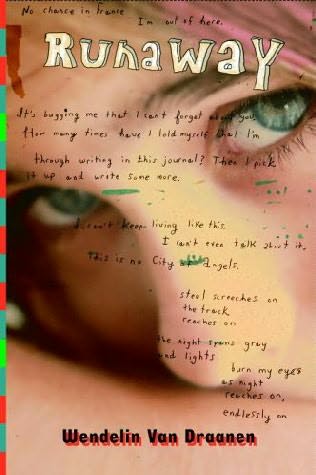
Runaway


Bibliography
Van Draanen, Wendelin. Runaway. New York: Alfred A. Knopf, 2006. Print.

image from: http://img1.fantasticfiction.co.uk/images/n32/n162759.jpg

My Thoughts
A student recommended I read this book. Glad she did. WOW! This was a great story, and I now have another book to recommend to my "reality" fiction readers.

This is Holly's story. Holly is twelve and has runaway from another foster home. This time, though, is different because she has a journal and a plan.

At the beginning of the novel, Holly is resentful of the journal. She hates her teacher that gave it to her to write down her thoughts and feelings. "You think writing will get me out of here? You think words will make me forget about the past? Get real, Ms. Leone!" (Van Draanen 1). She continues to write. She begins to emerge. She transforms. "Maybe I was mean to you. Maybe you really did care" (Van Draanen 46). By the end of the book, she realizes that the journal is one thing that helped her survive her situation. "The most important thing is that this journal made me feel less alone. Like I had someone to talk to" (Van Draanen 244). It has become her most prized possession. She writes, "You can steal my money, you can steal my food, but man, touch my journal and I'm going to beat the crud out of you! It's mine, you hear me?" (Van Draanen 127). 

Her situation: I felt empathy for Holly. She was truly a victim of circumstance. Her father was killed in a tractor accident that sent her mother running into drugs, eventually overdosing and leaving Holly thrown into the foster care system. She is placed and fights it. She is placed again and again until the people who are bond to help her actually fail her. They don't listen. They don't believe. My heart breaks for Holly because I realize that this happens. How many times have "good intentions" turned into a horrible situation? She leaves the last home and decides she will head west and become a sea gypsy. She stows away on a bus and makes it to California.

Holly is a survivor. She's a quick thinker and has been to exposed to more "life" than most grown adults. She is aware of her surroundings and figures out how to make it. The journal helps her. Just as she resisted writing, she resists people, but as she spends more time on the streets, she realizes that not all people are the problem. She also realizes "how ungrateful I've been. I can walk, I'm healthy...I've got a lot more than I think I do" (Van Draanen 159). Pretty powerful revelation from a twelve year old homeless girl!

Writing poetry becomes an outlet. As she rages against her life, she creates some beautiful stanzas. In one poem, she writes, "I'm mad at everything and everyone. Why am I having to go through this? What did I ever do to deserve this?" (Van Draanen 150). My sentiments for her as well.

Books and dogs help her. She finds libraries whenever she can and reads as much as she can. She relates to dogs and cares for them. She wants to become a veterinarian and take care of dogs

Fortunately, I have never had to live on the streets to survive. I've never been hungry enough to eat out of trash cans or steal food. I have never lived in a cardboard box covered in trash bags. I don't know if I could find a soup kitchen by watching other people. I've always had someone I could call given the opportunity.

One person that helps Holly is Louise K. Palmer. She is a homeless woman who thinks Holly is her daughter. Holly pretends so that she can enter the shelter and get a warm meal, shower and clean clothes. Holly makes up a story about Louise's life, "and while I was making up the story, I pretended that the comb was a magic comb, and that it was untangling all the knots of her life" (Van Draanen 51). I liked the imagery here.

Another person that helps Holly is the rescue-wagon lady. Not only does she feed Holly (and other homeless people), she notices Holly. "In the background, just observing, she noticed" (Van Draanen 131). This means so much to Holly. Finally, an adult who sees the good in her. The rescue lady not only feeds the homeless, she defies the police to do it. I was proud of her for throwing the sandwiches.

Walt Lewis and his wife also try to help Holly. They give her a warm bed for a few nights and food, but their "good intentions" drive her away and back onto the streets.

When Holly finds abandoned stuff, she believes she's having good luck. Then she feels confused. "Here I've snagged some homeless guy's sleeping bag, I'm using his mat, eating his food, cashing in his cans...He's homeless. How low can you go?" (Van Draanen 187). This good luck doesn't last long and forces her to move around again.

Holly meets Sammie at the soup kitchen. Holly finds out that Sammie's life is not what Holly imagined. Sammie is serving in the soup kitchen for required community service. Sammie ends up taking Holly to meet Vera and Meg. When I finished this book, I read the author's note and found out Sammie was actually the first story Van Draanen wrote (Sammy Keyes and the Sisters of Mercy), but so many readers wanted "to know more about the homeless girl that Sammy rescues in the story" (Van Draanen 247).

We leave Holly's story when she stays with Vera and Meg. This mother-daughter duo looks like a great fit for Holly.

I love the last poem Holly leaves us
scraps of love
torn and tattered
faded, scattered
trashed
 
threads of hope
frayed and tangled
broken, mangled
dashed
 
backing, buttons
yarn and batting
quilted tenderly
wrapped up in
this warm repair
my patchwork family
 
 (Van Draanen 242).

Wednesday, December 18, 2013

Unleash!

Bibliography
Noble, Perry. Unleash!: Breaking free from Normalcy. Carol Stream, IL: Tyndale House Publishers, 2012. Print.

image from: http://www.tyndale.com


My Thoughts
This is yet another book I received free at TLA. When I started reading it, I really wasn't into it. I kept thinking about all of the other things I could do/read/watch instead of this book. However, I stuck with it.

From the back cover: "Perry Noble challenges us to grab on to God's promise of full and complete living. Using the biblical story of David as a backdrop, he reveals the major barriers that often hold us back and keep us trapped in the mundane."

I liked the interweaving of David's story into a story of how we can live an "unleashed" life. I got out my spiral and took some notes while I read (I didn't have my flagging things close by to use.). Noble explains that "unleashing our lives is not about convincing God how great our plans are but rather understanding that we can live the life God has planned for us--right now" (Noble 11). Noble explains that "we think too small when it comes to the potential God has placed within us" (Noble 4). His example is amusing. He asks the reader to think of a number. "Nearly every time I do this experiment...they tell me a number in the ballpark of one to one hundred. But why? Why would we pick a number between one and one hundred when we have the option of choosing any number in the world? Why would we not pick 1,284,383?" (Noble 3). Good point!

I also found that while reading, I kept letting myself get distracted, or I was making connections between my religious teachings & beliefs and questioning what I was reading. This book really got me thinking about some things.

One thing Noble discusses is the "great American lie" where we say you can do anything you want to do. (53) I have told students some variation of this countess times. Noble argues that this is a lie because sometimes, there isn't enough belief in self or trying hard that can make some things possible. His examples are valid. However, Noble states that we are on "on this big ball of dirt called earth" for a purpose (Noble 55). God has a purpose for us. "The key to living a meaningful life is not to focus on what we want but rather on who Jesus is and what He wants for us. As we wrap ourselves up in Him, we find more purpose, meaning, and joy than we ever could have imagined" (Noble 55). Ok. I can believe that and I will stop spreading the "great American lie."

Another "ah ha" thing Noble points out in this book is the idea that "God never gives us more than we can handle" (110). Yes he does, according to Noble. God does so that we will learn to depend on Him (Noble 110). I am going to think about this the next time I want to tell someone this idea from 1 Corinthians 10:13.

Noble talks about three reasons we don't do what we know we should do (Noble 137).
  1. "I'll pray about it"--this is inactivity!
  2. Disobedience
  3. Procrastination
I thought his discussion here was good, relevant and accurate. I will be thinking about this more.

I also learned that "one another" appears in the New Testament more than 50 times (Noble 154). God wants people to connect and be in each other's lives and support each other. I struggle with this. I want to be helpful to others, but I'm not always able to accept others' help.

I know I read this book at this time for a reason (or perhaps many). I look forward to how the teaching of this book unfolds in my life. There are other things that I could write about, but I think it's more personal than I want to share on this blog. Again, I took notes, wrote down some interesting ideas/thoughts/scriptures I want to remember, and let the words reach me where I am.

On a critical note, the book seems to repeat some things. I wondered if this was because it was an unedited proof or Noble was driving a point home (sometimes this would apply) or he just had to repeat. Also, at times I thought that Noble might be putting in "personal" examples that weren't true. I know I shouldn't think a preacher lies, but at times I did question him. Maybe I was reading too close to the truth, and my doubts were the devil's shadow.

Sunday, December 8, 2013

Running: Getting Started

Bibliography
Galloway, Jeff. Running: Getting Started. Germany: Meyer & Meyer Sport, 2005. Print.

image from: www.jeffgalloway.com

Running Getting Started
My Thoughts
In June, I texted a friend who'd been running for a year and said, "I'm ready. Teach me to run." I started running with her, and she talked about the "Galloway method." I wasn't sure what this meant, but I did what she told me anyway.

This book explains the Galloway method (which is a run-walk-run method to avoid injury). As explained throughout the book, "I'm [Galloway] proud to be a wimpy runner who runs every day--instead of being forced to be a couch sitter because of never taking a walk break" (Galloway 225). It is a concise, informative and easily understood book geared to exactly what the title states--the beginner who is getting started. The book covers running basics, nutrition, and even how to enter and compete in your first race.

I like that the first chapter explains why people run. My friend who taught me is an artist. I marked the page in Galloway's book where he explains that "a number of artists...run because it improves their creative response" (Galloway 16). Running activates the right side of the brain---the "intuitive center of creativity" (Galloway 16). Chapter One also talks about the freedom during a run. There are no demands/distractions so "you can explore the inner parts that are YOU" (Galloway 19). Yep, I have felt that--even when I run with others.

Chapter Four discusses the most important equipment required for running--shoes. I didn't realize that runners wear shoes about two sizes bigger than the street shoe (Galloway 32). It makes sense, especially during those summer runs! I chuckled when Galloway wrote about "fashion injuries" that occurred when the shoe was picked because of the color match and not the comfort. His advice on when to purchase new shoes is helpful, too.

Galloway includes plans and starts the runner off slow but encouraging. It doesn't help to go full blast one day only to be down 3 days to recover from it. I kept thinking about the turtle--slow and steady wins the race (and as Galloway states wins it injury free!).

Something I learned from this book was about fast-twitch and slow-twitch muscle fibers. I don't think I've ever heard of this before, and I'm not quite sure I understand it well enough to know if I'm a fast or slow twitcher.

In the section about preventing injury, a surprising thing to read is Galloway's position on stretching. He says "don't stretch!" (Galloway 127). He states he's heard from runners that "either become injured because they stretched or aggravated the injury by stretching" (Galloway 127). The exception to this is when you have Ilio-tibial band injury. He also says to take 48 hours between runs. This break gives the muscles time for recovery. Later in the book, Galloway devotes an entire chapter to stretching.

As my regular running partner suffers from shin splints, I marked some pages that Galloway discusses regarding the reasons for and treatment of this pain. I think I will watch her form when running (and may have someone video me running to check my own form).

The book even has a "Trouble shooting" chapter. A funny thing I marked was inside a list of tips about street safety. Galloway writes, "Assume that all drivers are drunk or crazy or both" (Galloway 212). HA!

The book concludes with the "Being a good coach" chapter. Again, I thought of my friend who helped me get started and how I helped another friend come back to running. Running may be a singular sport, but it is more fun when done with others.

I look forward to reading more of Galloway's books as my own running journey continues.

Thursday, December 5, 2013

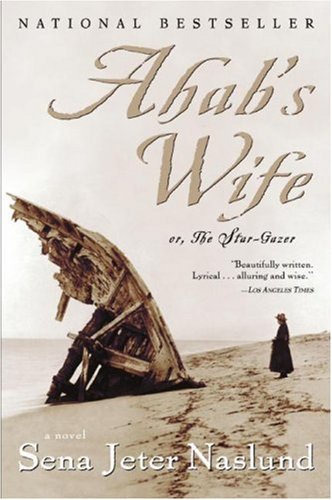
Ahab's Wife or, The Star-Gazer

Bibliography
Naslund, Sena Jeter. Ahab's Wife or, The Star-Gazer. New York: Harper, 1999. Print.

image from: http://d202m5krfqbpi5.cloudfront.net/books/1178657369l/817460.jpg

My Thoughts

Una has lived quite a life.

When I began this voyage through 600+ pages, I wasn't sure I would be able to complete the book. I have found that I don't enjoy books about the water (Billy Budd, The Old Man & the Sea, Moby-Dick--ok I haven't actually read that one. I've tried multiple times, but I couldn't keep with it), so what compelled me to read this book, I do not understand.

Una seems to be telling her story as a survivor. She already knows the outcome, but the reader must hear how she survived. The opening chapters are about her losing her beloved mother and child in the same night. Then the story moves backward in time to when her mother sent Una to live on the island with her aunt and uncle. On this island is a lighthouse that she and her cousin call The Giant. This reminded me of another book (Light Between Oceans). This start to Una's narrative is explained on page 619!

Una leaves the island to meet her mother. She ends up on sailing on a whaleboat with Giles and Kit. Their voyage is heart-stopping! Una is one tough girl. I found myself caught up in the language and nuances that Naslund writes. It is a beautiful, horrifying story. So much happens that after Chapter 50, I stopped reading to begin writing this blog. I have 25 flags marking various things at this point.

I was determined to finish this book over Thanksgiving break. I did it! I am amazed at how many things Naslund ties into her book. There is the main story of Una, but there are many other characters and ideas with a place in this tale. Naslund ties in religious affiliations (Quakers, Unitarians, even Methodists). She broaches the idea of slavery (Susan has a recurring story line & Frederick Douglass speaks at an event Una attends.). She brings in women's rights and the role of women in societies. "I did not just want babies, or men who went to sea. I wanted something for myself" (Naslund 124). Una declares that she will do as she pleases, "so long as I hurt no other being" (Naslund 204). Sadly, this doesn't quite happen to Una's expectations. Oh, and then of course the life in a whaling town. Naslund also shows the human connection and what sacrifices are made for the betterment of others (See Chapter 43!).

I began mentally tracking the references to Shakespeare (King Lear & Hamlet, mostly), great classic writers like Keats, Chaucer, Swift; stories of Beowulf & Greek mythology. Una's name is "from Spenser's Faerie Queen, because [her mom] wanted [Una] to be brave and true" (Naslund 400). Transcendentalism and Emerson, Margaret Fuller and even Nathaniel Hawthorne actually makes an appearance  (see page 490). Herman Melville's book is obviously present, although secondary, to this book. It was complete when Ishmael (David Pollack) is identified on page 646. Ahab appears on page 250.

Una is independent....Una is "a remarkable woman" (Naslund 191). Her story is interrupted in Chapter 57 when we hear Captain Ahab's Jottings. From here until the end, the reader gets a glimpse into other character's thoughts. At first, this bothered me. Why did Naslund spend 260 pages in Una's voice to insert others? However, after finishing the book, I understand that we needed those insights.

It takes 360 pages, but Una FINALLY becomes Ahab's wife. We had to travel that far in Una's story before she could marry Ahab. Once they are married, Una's life drastically changes. Her position in society elevates. Even with her privilege, she faces hardships. In her hardships, she befriends Susan, David Poland, the Mitchell Family, the Judge, and a neighboring artist. It is almost like this book could be two--one story of Una's life before Ahab and another story of her life after Ahab. However, that would not make her complete story. Naslund's book does. There is so much that happens that I'm not doing the book justice here.

It isn't until page 609 that Una is persuaded to write down her story (hence the narrative voice). Again, with the interruptions of other characters' thoughts, parts of the story seem a stretch. I did think it was a bit over the top to have Nathaniel Hawthorne and Frederick Douglass play a part in the story. I think that is hindsight (and poetic licensing) to let these paths cross Una's.

Some writing I liked in the book:
  • "'Sometimes I like the public space,' she said. 'It's where the most private things can be said, confidentially.'" (Naslund 320).
  • "'It's always that way. In learning, one thing always has something else in it, or leads to something new'" (Naslund 408).
So, I sailed the story of Una Spenser, Ahab's wife. I actually thought it was good--in spite of the water. Maybe I'll give Moby Dick one more try.


Monday, November 11, 2013

Readicide

Bibliography
Gallagher, Kelly. Readicide: How Schools Are Killing Reading and What You Can Do About It. Portland, ME: Stenhouse Publishers, 2009. Print.

image from: http://kellygallagher.org/books_dvds/books_dvds.html


Summary of the book from Kelly Gallagher's website:
"Read-i-cide n: The systematic killing of the love of reading, often exacerbated by the inane, mind-numbing practices found in schools. Reading is dying in our schools. Educators are familiar with many of the factors that have contributed to the decline — poverty, second-language issues, and the ever-expanding choices of electronic entertainment. In this provocative new book, Kelly Gallagher suggests, however, that it is time to recognize a new and significant contributor to the death of reading: our schools.

In Readicide, Kelly argues that American schools are actively (though unwittingly) furthering the decline of reading. Specifically, he contends that the standard instructional practices used in most schools are killing reading by:
• Valuing the development of test-takers over the development of lifelong readers;
• Mandating breadth over depth in instruction;
• Requiring students to read difficult texts without proper instructional support;
• Insisting that students focus solely on academic texts;
• Drowning great books with sticky notes, double-entry journals, and marginalia;
• Ignoring the importance of developing recreational reading;
• And losing sight of authentic instruction in the shadow of political pressures.

Kelly doesn't settle for only identifying the problems. Readicide provides teachers, literacy coaches, and administrators with specific steps to reverse the downward spiral in reading—steps that will help prevent the loss of another generation of readers."


My Thoughts
I'd heard something on my library list-serv about this book. My library already owned it, so I put it on my "to read" pile. Very interesting read (and only 118 pages)! I wish I'd read it while I was still an English teacher. I would have changed a few things about my teaching.  Fortunately, I still work with a group of high school students and think I can use some ideas with them. The book also confirmed some things I did right in the classroom and helped me think about how I can help students in my role as librarian.

Testing is killing curriculum. There is no question about this.  The data that administrators and legislators use to decide if teachers are doing their job are not factoring in the human component. Teachers are not producing widgets, we are trying to educate a human being. Each tester must fit into a box (yet, ironically, we constantly talk about thinking outside of boxes!).

I liked how Gallagher examines readicide and gives teachers some ideas on how to still play well with the people who care more about the test than the student while really helping students learn how to enjoy reading--even when the text is difficult. He states that "if students are taught to read and write well, they will do fine on mandated test" (Gallagher 26). YES!

We need to expose kids to authentic reading and give them experiences to have prior knowledge when they read. "Kids without prior knowledge are at a disadvantage, regardless of reading ability" (Gallagher 38). He gives an example from an actual state mandated test about "The Farrier." Students without prior knowledge had no idea what they were reading. He later gives an example using baseball. As an avid fan myself, I had to "decode" the words being used. I understood the words, but not always the meaning. Very eye-opening!

Gallagher also validates the use of SSR in the classroom. Gallagher states, "SSR is actually a valuable investment in test preparation...SSR is necessary to allow students an opportunity to build their prior knowledge and background...[and] SSR provides many students with their only opportunity to develop a recreational reading habit" (42). HIP, HIP, HOORAY from this teacher!

One of my favorite analogies Gallagher uses is the movie. He gives an anecdote about a student saying her reading time was "ruined by the teacher's insistence on repeatedly stopping to that students could analyze the book" (Gallagher 59).  He continues the explanation with a question, "Would you stay in a movie theater if the projectionist stopped the film twenty-two times?" (Gallagher 61).

This book is powerful! I want my English department buddies to read this; I want my principal to read this; I want our curriculum director to read this; I want my teacher friends in other schools to read this; I want my daughter's teachers to read this. In fact, I've changed my email signature to tell everyone they should read this book.