Tuesday, September 16, 2014

Full of Heart

Bibliography
Martinez, J. R. Full of Heart: My Story of Survival, Strength, and Spirit. New York: Hyperion, 2012. Print.
image from: www.amazon.com


My Thoughts
J. R. Martinez was a keynote speaker at the Texas Library Association conference in 2013. His story is remarkable, and I was excited to buy his book. Here's me getting the book autographed.
I liked how honest he was in telling his story. I thought about what he told us at TLA and how similar to the book (minus the cussing) his presentation was. Also included in the book are pictures. (He may have shown some of these in his presentation, but I can't remember now). His childhood was not idyllic, and he makes no excuses.

When he was in high school, all he wanted to do was play football. "While I'd never been the most talented on the football field, I had a tremendous amount of self-assurance and a strong work ethic" (Martinez 54). He moved before his senior year to Dalton, Georgia. There, he made the football team. His coach told him making the team had "'nothing to do with your ability and everything to do with your attitude'" (qtd. in Martinez 55). He was "full of heart" (title reference here!) and became "J.R." instead of "Jose Martinez" to start a new beginning (Martinez 55).

After high school, J. R. joined the army and was sent to Iraq. While on patrol, his Humvee hit a roadside bomb. (This happens on page 93 of the book).  I appreciate the honest description of his time in the hospital. He was mad. He was in pain. He thought his life was over (he was only 19 when the accident happened). There's a good portion of the book dedicated to both the physical and emotional rehab that J.R. went through in order to heal. As a reader, I felt like part of me was sitting beside his hospital bed. I understood his mother's concern and was so proud of the town of Dalton rallying around this family.

I marked a part in the book that I kept thinking while reading.
"One thing about being in the spotlight is having people come up to me because they've heard my story or read an article about me or watched me on television. Almost invariable, they say, 'I don't think I could've gone through that at age nineteen.'
And almost invariable, I say, 'With all due respect, what makes you think I was ready to go through that?'" (Martinez 226).
Martinez then goes on to explain why he wrote the book. "People need to understand and accept that everything we go through in life will prepare us for our own big explosion....No matter what, we are all going to face the unexpected (and unwanted) challenges in our lives, and what matters is the way we cope" (Martinez 226).
 
Reading this book stayed with me. It's been several weeks since I finished, but I still think about how this man became an inspirational speaker. He shouldn't have. Not to sound rude, but he should have just been another guy that only his family and friends would know.  It was interesting to me how he ended up becoming a household name. He was on a very popular soap opera. He was a "Dancing with the Stars" winner. He speaks to large groups. How did this kid from all over and nowhere accomplish this? I think this book is inspiring!




Friday, August 29, 2014

Burned & Smoke

Bibliography
Hopkins, Ellen. Burned. New York: Margaret K. McElderry Books, 2006. Print.
Hopkins, Ellen. Smoke. New York: Margaret K. McElderry Books, 2013. Print.
images from: www.amazon.com
   

My Thoughts
I decided to write about both of these books together, as they are a series, and I read them as a continuing story. I thought these would be books about a burn victim. I was wrong.

Burned is the story of Pattyn Von Stratten, a Mormon girl who tries to reconcile her church's doctrines with her abusive father's behavior. The church seems to turn a blind eye to the abuse, but Patty can't. Patty sees her mother's life and knows that's not what she wants for herself, but she also doesn't see other options. Patty is smart, funny and insight and much like other teenagers, she is seeking the answers to the "big" questions of life.

When her father finds her in a "compromising" position with a classmate, Patty is sent to live with her Aunt Jeannette (Aunt J) across state. Aunt J hasn't seen the family in years, but is the only one who agrees to take Patty in after her "sinful" actions.

This is just the medicine Patty needs. At Aunt J's, Patty learns independence and has freedom and learns another side of her family's story. She also learns how to ride a horse and actually falls in love with Ethan.

Burned ends with Patty back at home, but she is making plans for her escape. Once she's realized there's more in the world than her super-strict, abusive father's ways, she's ready to go. She feels bad for her younger siblings, but she cannot stay in that house with her meek, delusional mother and her ever drunk, angry father.

This is where Smoke begins. This book alternates between Patty's story and her sister Jackie April Von Stratten. Boy, the sister's story of being left behind is worth reading.  At the beginning of this book, Patty has left her family and is on the run. Not all events, however, are as they appear. Without spoiling what happens here, I will say that I'm happy Hopkins decided to pick up Jackie's story and propel Patty's story with the alternating scenes. I liked seeing what was happening with both girls during the same time.

As we read Jackie's story, though, I was DISGUSTED by the mother's actions (or absence of actions). How could she reason that her decision was really "best" for Jackie? I was so proud of Jackie for pushing forward and using her brains to figure out a way to get back at those who hurt her. She is a strong character.

One of my favorite chapters is "The Library."
It was a safe haven. Not sure if it's the same in every school, but here, the stacks are fortresses. I love the smell of books, even old ones, as most of these are, at least the nonfiction. Ms. Rose [the librarian] collects young adult novels, so there's a wide selection of fiction. Everything from vamps to vampires, she likes to say, and that's an apt description. Pattyn's a huge reader, and she passed that passion on to me. Books were her escape, and they are mine, too. The best, I have to hide, or at least I did while there was any chance Dad might find them (Hopkins 178).
I hope my students feel the same way about my library. I hope it is a fortress and a refuge (even though I hope they are not dealing with the same things that Patty & Jackie are).

These two books are not as gritty as the Crank series, nor as graphic as Tricks. That's fine with me. I enjoy that Hopkins writes compelling stories about characters that, fortunately, I cannot identify with, but I do have empathy for while bringing awareness to experiences that are very real.


Monday, August 25, 2014

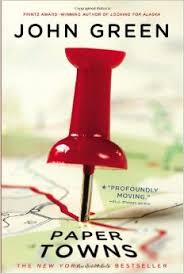
Paper Towns

Bibliography
Green, John. Paper Towns. New York: Speak, 2008. Print.
image from: www.amazon.com

Plot Summary (from back cover)
"Quentin Jacobsen has spent a lifetime loving the magnificently adventurous Margo Ruth Spiegelman from afar. So when she cracks open a window and climbs into his life--dressed like a ninja and summoning him for an ingenious campaign of revenge--he follows. After their all-nighter ends, and a new day breaks, Q arrives at school to discover that Margo, always an enigma, has now become a mystery. But Q soon learns that there are clues--and they're for him. Urged down a disconnected path, the closer he gets, the less Q sees the girl he thought he knew."


My Thoughts
This is the last John Green book for me to read. I almost didn't want to read it, so I would still have it to read "one day." Alas, I did start it, and I was not disappointed. This was a cute, humorous read, typical of Green's style--awkward teen seeks to find himself and discovers a greater truth.


You see how fake it all is

When Margo and Q are having the night of Q's life, Margo explains what a paper town is. "From here, you can't see the rust of the cracked paint or whatever, but you can tell what the place really is. You see how fake it all is. It's not even hard enough to be made out of plastic. It's a paper town. I mean look at it, Q: look at all those cul-de-sacs, those streets that turn in on themselves, all the houses that were build to fall apart. All those paper people living in their paper houses" (Green 57). Later in the book, the reader learns a different description of paper town. It was a "fictitious village created...and inserted into tourist maps as a copyright trap, or paper town (Green 235). Hmmm....interesting. I didn't know that. Apparently this practice was common in mapmaking.
I loved the description of Q's friend's car. "RHAPAW was a fifteen-year-old Buick that had been driven with impunity by all three of Ben's older siblings and was, by the time it reached Ben, composed primarily out of duct tape and spackle...RHAPAW ran not on gasoline, but on the inexhaustible fuel of human hope" (Green 90). Oh, how I laughed here. When I was in high school, a neighbor took several of us to school in his Ford Fairmont. This car was in decent shape on the exterior, but it, too, ran on human hope. We would sit in the parking lot after school waiting for kids to leave before even trying to start the engine.

Another funny car scene is when Q's parents surprise him with a vehicle on his birthday. His reaction is SO FUNNY! (I don't want to spoil it here, but you'll understand when you get to that part in the book).

Almost the entire road trip the kids take had me laughing. The way Green logs the travels (and subsequent misadventures here) was funny. I could see it happening--all of it!

Good advice that Green shows through his characters "You know your problem, Quentin? You keep expecting people not to be themselves" (Green 194). Wow! That is so true. How often I have been disappointed in someone, only to realize I shouldn't have been. They are being true to their character.

One thing I did not like about the book, though, was the ending. I feel like I'd been on an adventure/mystery/scavenger hunt with Q, and then the ending is rushed. I've thought about how Green could have made the story end differently. I'm not sure I would like the alternative, either. Maybe this could have been a "Choose your own adventure" type ending. If you think X happens, turn to page ___. If you think Y happens, turn to page ____."


Tuesday, July 29, 2014

When Mockingbirds Sing

Bibliography
Coffey, Billy. When Mockingbirds Sing. Nashville: Thomas Nelson, 2013. Print.
When Mockingbirds Sing, Billy Coffey
image from: http://www.thomasnelson.com/when-mockingbirds-sing

My Thoughts
This was a free ebook download. I read it over the course of months, as I would find myself with a little time and my phone handy. There were several accolades in the front of the book claiming this to be a wonderful read. I was excited.

I kept wondering what was going to happen and how things would connect. This wonder kept me reading. There is a bit of mystery in the story, so I kept reading. The characters seemed a bit contrived, but I kept reading. The plot created unconnected episodes, but I kept reading. When I finally finished the book, I wondered why I kept reading. I know the theme of the book is hope, faith and rely upon God (or things unseen as God), but I was disappointed when I finished. The book slogged along forever, then abruptly wrapped itself up in a twister (pun intended).

I think this is supposed to turn into a series. I hope if it does, Coffey explains some things. For example, I'd like to learn more about why the dad's psychiatric practice was reduced to one patient. This patient circles back into the story, but at first it seems a distraction (Is this the metaphor that we often don't understand God's plan and things seem like a distraction?).

I also missed why the mockingbirds just showed up at various people's homes. Was this supposed to be an omen? Why mockingbirds? I think grackles are more ominous and annoying. Maybe I skimmed the explanation because I was just trying to get through the book.


Monday, July 21, 2014

Mrs. Poe

Bibliography
Cullen, Lynn. Mrs. Poe. New York: Gallery Books, 2013. Print.
image from: http://d.gr-assets.com/books/1378705735l/16130398.jpg


My Thoughts
6/24/14
Who wouldn't want to read a book entitled Mrs. Poe? I was thrilled to receive this as a birthday present. I started reading yesterday and knew I would like this book! The preface to Chapter 1 is Edgar Allan Poe's poem The Raven. LOVE, LOVE, LOVE!

7/3/14
I'm about half-way through the book now and am enjoying it. I love how the author pulls in so many factual people and places to this story. "Not now, Hawthorne! I'll read your draft of The Scarlet-whatever as soon as I can" (Cullen 120). The author is witty. This story makes me wonder if Francis Osgood really did exist (I've not heard of Poe having a mistress before this book). I like that I get to see Virginia Poe more as a person instead of "the wife of Edgar" and nothing else mentioned.
7/7/14
I finished the book and enjoyed it all the way through the story. I was amused at Poe's character and others' reactions to him. Some admired him so and fell all over themselves to be near him while others held him in disdain (and Poe didn't seem to care). I liked seeing the romance blossom and the infusion of different poems. I also liked the ending twist. Something happens that I've never heard of in connection to Poe. I need to do some research.


The story takes place over two years.

Tuesday, June 24, 2014

Twelve Years a Slave

Bibliography
Northup, Solomon. Twelve Years a Slave. Auburn: Derby and Miller, 1853. Print.
image from: http://i43.tower.com/images/mm124192110/twelve-years-slave-solomon-northup-paperback-cover-art.jpg

My Thoughts
I couldn't get through this book. I couldn't even make it half-way through this book, and it's only 138 pages long!

Solomon is a free black man. Through some trickery, he is enslaved and is headed to Louisiana. That's as far as I got. The story does not compel me to read more. It is certainly written in the style of the time--very descriptive and formal.

I watched the movie (did get through that), but it did not inspire me to finish the book. Maybe another day...probably not. 

Monday, June 16, 2014

The One

Bibliography
Cass, Kiera. The One. New York: Harper Teen, 2014. Print.

image from: https://p.gr-assets.com/540x540/fit/hostedimages/1380860857/3138132.jpg

My Thoughts
Well, it's been several weeks since I finished this book, but with the end of school and inventory and Upward Bound starting, I'm just sitting down to blog about it.

This is the third installment of America and Maxon's story. The book released May 6, and I bought my own copy that weekend because I couldn't wait until I could buy a copy for the library. This story was good and I had to find out which way did America choose--would she be Aspen's or Maxon's wife? I figured the title would help me know, but I was not banking on it, and with the turns Cass provided in this third story, I was correct in being suspicious.

It's down to four girls, "the Perfectionist, the Sweetheart, the Diva...and me" (Cass 213). Maxon & America learn more about their country's history when they meet August. They share a tension of what their future holds. They are anxious about admitting their love and anxious about learning of each other's past.

I marked some pages that I thought were interesting, but now that time has passed since reading this book, I'm not sure I want to share what I marked on this blog. This story is one to be experienced, and I'm afraid anything I write will spoil the story.

I will say that I'm glad I read a book "out" of my genre. This series has been delightful!